



Kate Kimmel
Fernandina Beach commissioners unanimously approved the second reading of an ordinance June 17 establishing new regulations for electric bicycles and other personal mobility devices, citing a rise in complaints and injuries involving the vehicles.
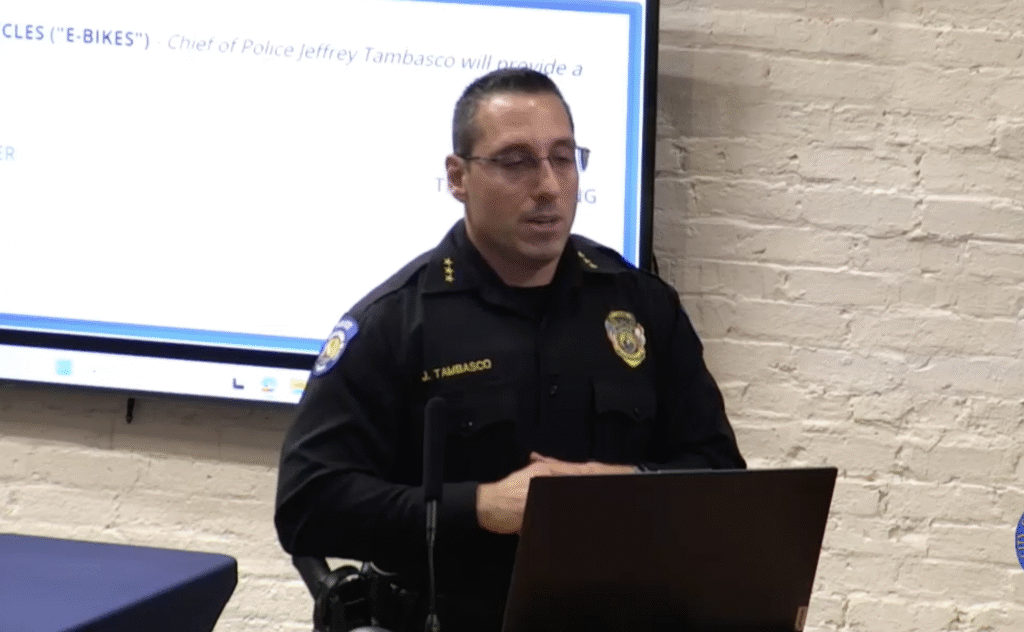
The ordinance amends the city’s traffic code by creating definitions for electric bicycles and other personal mobility devices and establishing where they may be operated and at what speeds. A third and final reading is scheduled for July 7.
“This ordinance amends the traffic and vehicles section of the city’s code of ordinances by creating definitions for electric bicycles and other personal mobility devices and creating laws to restrict the usage of these vehicles to certain speed limits,” City Attorney Teresa Prince said.
Under the proposed ordinance, all bicycles, electric bicycles, motorized scooters and mopeds must obey the same traffic laws as other vehicles, including traffic signals and stop signs. Riders will be limited to 25 mph on roadways and 10 mph on trails, multiuse paths and the beach.
Commissioners increased the roadway speed limit from the original proposal of 20 mph after hearing concerns from cyclists that experienced riders on traditional bicycles can exceed that speed without electric assistance.
The ordinance also limits sidewalks and unpaved rights of way to human-powered bicycles only, which can include ebikes with motors turned off. Electric bicycles and other motorized devices would be prohibited from operating in city parks, including the municipal golf course, unless signs specifically allow them.
The proposal emphasizes that riders must yield to pedestrians and notes that violators may be cited for careless driving under both the city ordinance and recent changes to Florida law.
The ordinance follows months of discussion about e-bike safety. During a Jan. 6 commission meeting, Police Chief Jeffry Tambasco said the Fernandina Beach Police Department recorded 188 complaints involving juvenile e-bike riders in 2025. At the June 17 meeting, Prince cited data from Wolfson Children’s Hospital Trauma Center showing a 3,700% increase in pediatric admissions related to e-bike and e-scooter injuries since 2022.
Commissioner Joyce Tuten said the additional weight of electric bicycles makes crashes more severe than those involving traditional bicycles, even at the same speed.
“A rider on a human-powered bicycle versus an e-bike going the same speed is very different because an e-bike weighs twice as much,” Tuten said. “When you increase the mass, you directly increase the force. An e-bike going 10 mph is much more dangerous than a regular bike because e-bikes are often twice the weight.”
Florida lawmakers this year expanded local governments’ authority to regulate electric bicycles, allowing municipalities to establish minimum rider ages, require government-issued identification for operators and provide mandatory safety training. State law continues to define an electric bicycle as a bicycle equipped with operable pedals and an electric motor producing less than 750 watts.
Depending on the class, the motor provides assistance up to either 20 mph or 28 mph. Unlike traditional bicycles, electric bicycles use motor assistance but generally retain the same rights and responsibilities as conventional bicycles under state traffic laws unless restricted by local ordinance.
Prince said she and Tambasco discussed whether the city could require education instead of relying solely on fines.
Under the proposed enforcement system, a rider’s first violation would result in a warning. On a second violation, the rider could either complete an approved online safety course within 30 days or pay a $50 civil penalty. After completing the course, any subsequent violations would carry a $50 fine.
Prince said several online training options are available, including a free course offered by the League of American Bicyclists, a $15 course through the National Traffic Safety Institute and a $35 e-bike safety course.
Mayor James Antun asked whether repeat offenders could eventually be prohibited from riding their e-bikes within the city. Tambasco and Prince said they researched communities that confiscate bicycles but concluded that doing so would primarily punish parents who purchased the bikes rather than the children riding them.
The Police Department has already begun educating riders before the ordinance takes effect.
“We have started with the middle school before they went on break for the summer,” Tambasco said. “We have drafted a pamphlet that outlines the entire ordinance. Of course, we’ll do a huge educational push on this.”
Commissioner Genece Minshew said she was pleased the ordinance specifically addressed the city’s golf course.
“I’m glad we could call out the golf course,” Minshew said. “We had an incident on the hole behind my house last week. There were two 10-year-old boys jumping the bunkers, tearing up the bunker sides and doing wheelies across the green.”
The third reading of the ordinance is scheduled for July 7, which will include the changes to speed limits.
kkimmel@nassaunewsline.net