



By Beth Jones
The iconic concrete bleachers at Fernandina Beach High School, FBHS, have been demolished and will be replaced with metal grandstands and a press box in time for the home opener on Aug. 21.
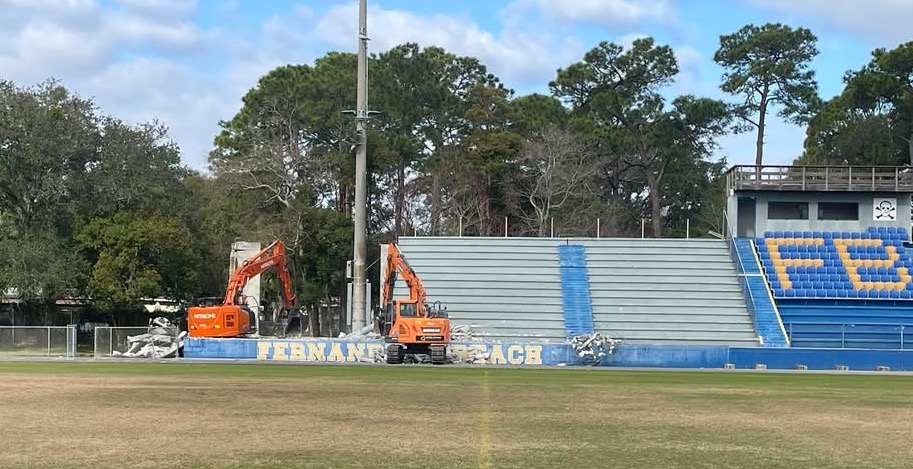
The bleachers witnessed decades of athletic events and school functions, not just in the years they’ve stood at Pirate Stadium, but also through many seasons prior to 1987 at Buccaneer Field.
Ken Roland, former athletic director and longtime baseball coach at FBHS, remembers the move well. He was an assistant football coach at the time.
“The Quarterback Club, which was very active then, built the risers,” he said.
The pre-stressed concrete double-Ts were placed on the risers, and the work was led by a parent.
“It went down Beech Street,” he said. “They just tore it all up and loaded those up on a big trailer. We had a ready-made stadium in less than a year.”
The bleachers were the home stands for football games, from Pop Warner to high school, and welcomed families for many graduations. They were the first-base stands for high school and senior league baseball games, too.
“I grew up here, and my father and mother played softball in that complex,” Roland said. “I was here when the Minor League teams for the Orioles and the Twins trained here, so I have very fond memories of that whole complex down there.”
He also remembers when high school football was played on two different nights.
“The Peck High Wolves would play on Thursday night, and we would play on Friday night,” Roland said. “I remember as a little kid watching both.”
Buccaneer Field was the heartbeat of the city.
“It was the center of everything,” Roland said.
While Little League games were played at Joe Velardi Field behind the Atlantic Avenue Recreation Center and at Elm Street, almost every other outdoor sport was played at Buccaneer Field.
“They would put up a temporary fence for baseball and take it down for football,” Roland said. “It was a multi-purpose field before multi-purpose became trendy.”
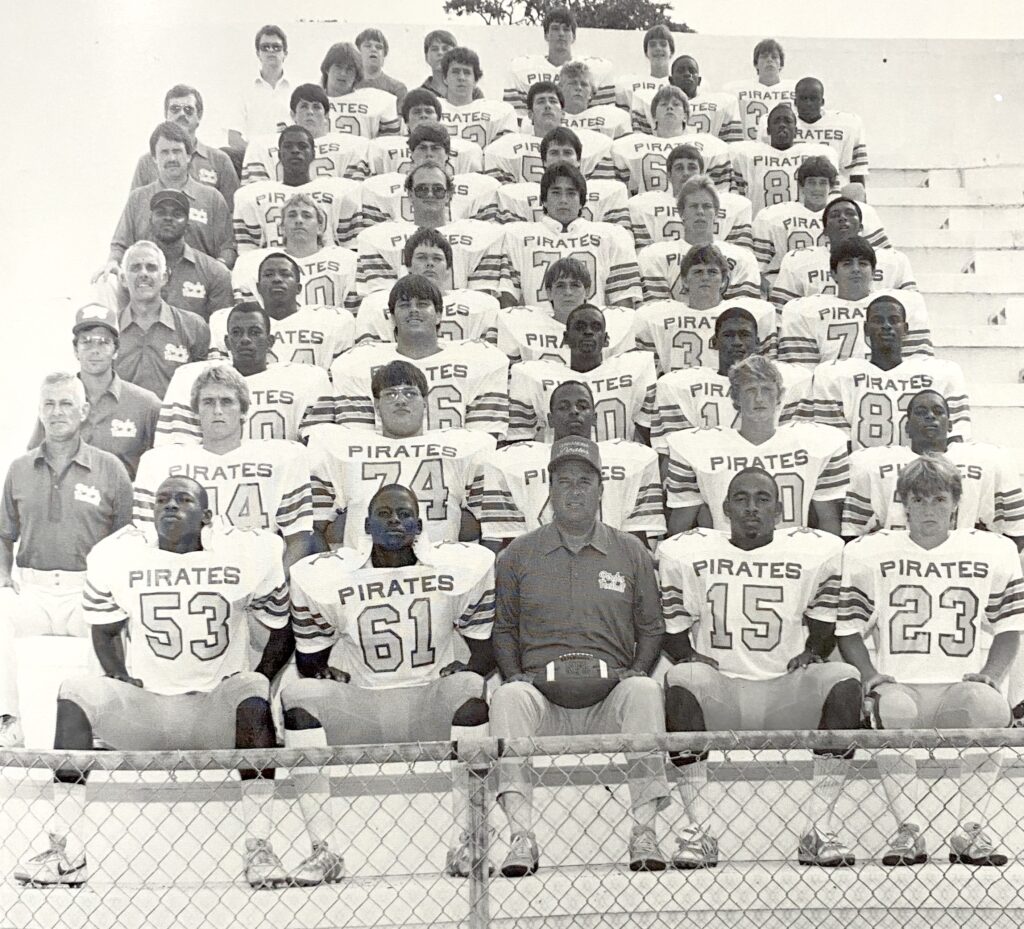
While FBHS football practices were held on campus at the old high school, currently the middle school, teams had to load the bus every Friday night – even for home games.
“We rode the bus down Beech Street and into the field,” said Roland, who also remembers missing that bus after a game.
“After we beat Alachua Santa Fe in 1985, (assistant coach) Larry Phillips and I got left behind,” Roland said. “We had to walk down Beech Street back to the school. We missed the bus with the celebration. That’s the way it was every Friday.”
Roland said everyone wanted the field at the high school, “but it’s hard to see that place go. We have such fond memories. It’s where we all played growing up.
“I remember playing baseball in high school and looking up and seeing my mother sitting in those first-base stands. We always said there would be nothing like the Buc.”
While the football team moved to the high school, Roland, head baseball coach at the time, and his team remained at Buccaneer Field until 1992.
“We practiced down there in those days, too,” he said.
Buccaneer was and still is owned by the city.
“When the school board and the city worked together, it felt like a true community field,” Roland said. “It certainly was a gathering place in the center of town. That part is always sad, but we like what we have here.”
Joel Stockstill moved to Fernandina Beach from Georgetown, Ky., in 1975 to serve as head football coach and athletic director at FBHS.
“We really loved it here,” he said. “I’ve been here ever since.”
Stockstill’s sons, Rick and Jeff, were quarterbacks, and his daughter Bonnie played tennis and was a cheerleader.
“She was the homecoming queen, too,” Stockstill said.
The Stockstill’s spent a lot of time at Buccaneer Field back then.
“Buccaneer Field was the first place we competed, and it has a lot of great memories,” Stockstill said. “It was so nice for people in the community. They really came out and supported us.
“Everything seemed to go on around Buccaneer Field. It was the hub of everything that went on.”
Stockstill pushed for the field to move to the high school.
“It was kind of inconvenient,” he said. “We had no locker room to go to at halftime. We basically did all our coaching at halftime in the end zone.”
Stockstill started the Quarterback Club, and members quickly stepped up.
“I think it was Frank Hickman, Dave Caples, BJ Littlefield, some of those fellas, really got behind the idea of having the stadium built,” Stockstill said. “We had tremendous support for moving it and playing on our fields. It turned out to be one of the best moves I think that’s happened in this town.”
The Pirates had a new field, but the field house was built later.
“You wasted a lot of time leaving the field and coming back to the locker room at halftime, valuable time to talk to the kids,” Stockstill said. “Other than that, it was nice.”
Players took pride in their new field.
“After practices and on Saturdays after the field was grated, ready to sod, we would walk in lines picking up rocks off the field,” Stockstill said. “We would pick up stones and wood to help clear it off; carry blocks to the workers who were putting the stadium together.
“The players carried the blocks up and helped out. It was pretty much a team effort.”
Stockstill said the Pirates relished their first season in their new digs.
“Being able to protect our home field made a big difference to the kids,” he said.
bjones@nassaunewsline.net