



By Kate Kimmel
Nassau County officials issued a statement Thursday, Jan. 22, contesting allegations made by Florida Chief Financial Officer Blaise Ingoglia that the county engaged in more than $53 million in excessive or wasteful spending.
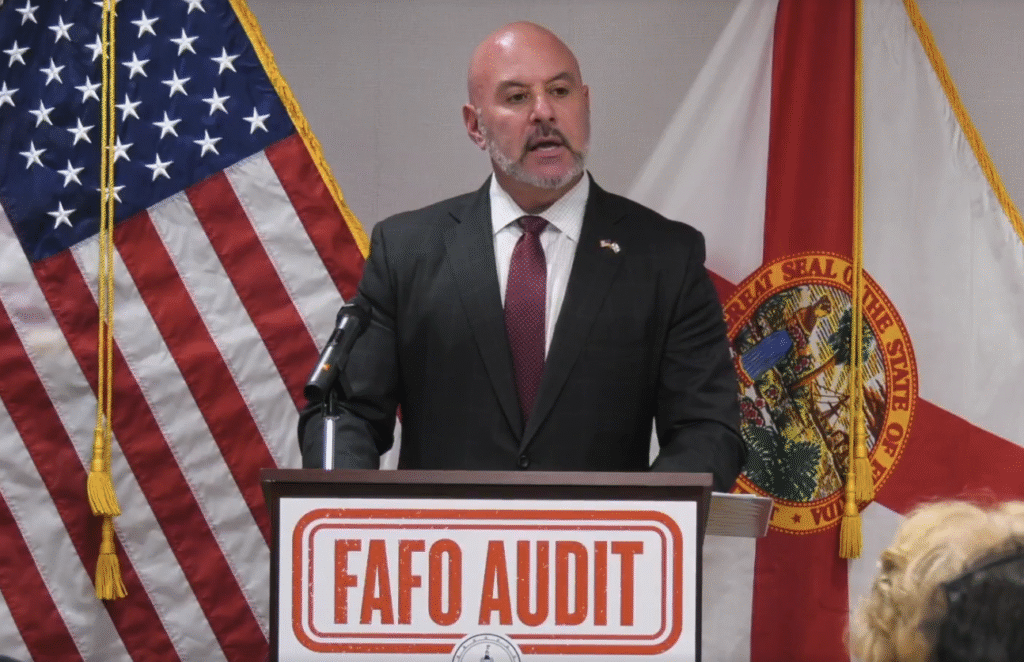
Nassau County was the most recent of 12 counties included in Ingoglia’s statewide tour, during which he has accused local governments across Florida of overcharging taxpayers for what he describes as “government bloat.” Speaking at a press conference Wednesday in Fernandina Beach, Ingoglia said an audit conducted by the Florida Agency for Fiscal Oversight showed the county’s budget grew by an amount his office considers excessive. He said that figure exceeded $53 million.
In response, the Nassau County Board of County Commissioners said the CFO’s analysis contains major miscalculations and incorrectly attributes decisions made by state mandates and voters to the board. The statement said the audit has not yet been released publicly, and county leaders are asking for the data and methodology behind the findings.
Board Chair Alyson McCullough said the county’s independently audited financial records do not align with the figures cited by the CFO’s office. According to the county, its own audit shows spending approximately $43 million less than the number presented by Ingoglia. The statement described this as a “concerning discrepancy.”
The county also said the state’s analysis labeled its land acquisition program as wasteful, despite a 2024 referendum in which 68% of voters approved the initiative. It argued that some costs identified by the CFO’s office were reserves for emergencies and previously budgeted capital projects that should not be included in the revenue calculation.
County officials further noted that certain state-mandated expenditures such as funding for jail facilities, Medicaid and public health services are beyond the commission’s control and should not be counted as discretionary spending.
County leaders said state auditors did not seek to meet with county commissioners, staff or the county clerk before publicly releasing their findings.
The methodology used in the CFO’s audit started with FY2019/2020 budget numbers, and indexed them every year for inflation and population growth to identify what a reasonable budget would be for FY 2025/2026, Ingoglia said.
“[The current budget] is the amount that the government only got because of increases in prices, and they took that money and spent it. And they expanded programs they should not have been expanding; they added programs they should not have added. They hired a whole mess of full time employees. They increased the administrative state.”
At the press conference, Ingoglia said the county’s budget increase equated to roughly $5,797 per new resident over the past five years. He has promoted reducing millage rates and increasing transparency in local government spending during his statewide tour.
“This exercise is not going to be limited to just the general government. The school boards are going to be going through this exercise also because we believe that school boards are wasting money also.”
Ingoglia is advocating for legislation to establish the Florida Agency for Fiscal Oversight (FAFO) as a statutory state agency with broader authority to review local government spending. According to a Department of Financial Services release dated Dec. 17, 2025, the initiative aims to make these audits a permanent function targeting waste, fraud and abuse.
The Dec. 17 release states that the proposal would require local governments to submit annual financial efficiency reports and upload contracts to a state database. It also notes the legislation would grant the state power to withhold funds or recommend the removal of local officials for financial mismanagement. The initiative functions under the Department of Financial Services, alongside the Office of Fiscal Integrity, and follows a series of 2025 audits that Ingoglia said identified questionable spending on items such as DEI training and community events.
“It is also important for voters to understand the context in which recent statements were made. The CFO is currently a candidate for public office, and in any campaign season, political rhetoric can escalate,” McCullough said. “I encourage taxpayers to do their homework, look past soundbites and go directly to the source — our audited financial records, which are publicly available through the Clerk’s office.”
Ingoglia has announced his candidacy for re-election as Florida’s Chief Financial Officer.
Nassau County audit reports can be accessed by visiting the Clerk’s Office website – www.nassauclerk.com – clicking the drop-down arrow next to “Clerk’s Office,” and selecting “Financial Reports.”
Commissioner Klynt Farmer said county staff and the clerk’s office have been directed to review financial records in detail and post the results online for public review once that work is complete. Commissioner A.M. “Hupp” Huppman said Nassau County expects that a transparent evaluation will show the county meets the relevant fiscal thresholds.
Anticipating a statement from the County during his Wednesday appearance, Ingoglia said: “Local governments are going to come out and try to refute our numbers. They can’t. They try to excuse it away but they can’t.”
kkimmel@nassaunewsline.net