



By: Kate Kimmel
Nassau County residents — particularly those living in rural areas — face significant barriers to accessing health care, with the county trailing state averages in several key health measures, according to a newly released community health assessment.
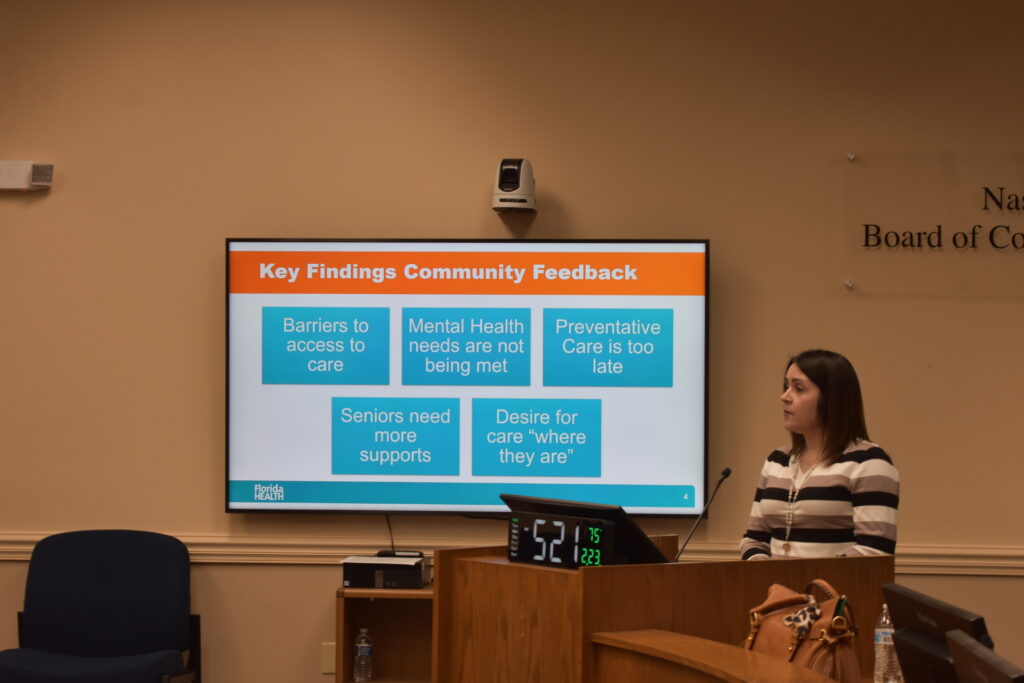
The 2025 Community Health Assessment from the Florida Department of Health was presented to county commissioners Monday by Cara Gluck, health administrator for the Florida Department of Health in Nassau County. The report identifies transportation, preventive care and mental health services as the county’s most urgent areas for improvement.
“Unfortunately for preventive screening, we are falling below the Florida average and the Healthy People 2030 average here in Nassau County,” Gluck told commissioners.
The assessment is based on more than 5,000 resident surveys, input from 22 cross-sector stakeholders, three community focus groups held in Hilliard, Yulee and Fernandina Beach, and interviews conducted over the spring and summer of 2025.
Data in the report show Nassau County ranks below the state average in several preventive care categories, including child wellness visits, early prenatal care, colorectal cancer screenings and adult dental visits. Gluck said health care providers reported that many residents arrive at emergency rooms with conditions that could have been prevented with earlier access to care.
“Our residents are not being screened for very preventable chronic disease and or cancers,” she said. “If we had additional access to care or specialty providers, we would be able to help them from that prevention perspective.”
Economic barriers also play a major role. The report found that 41% of Nassau County residents live in households that are asset-limited and income-constrained despite being employed, commonly referred to as ALICE households. Among those residents, 62% reported that cost is a barrier to receiving health care.
According to the Florida Department of Health, an ALICE household consists of residents who are “asset-limited and income-constrained despite being employed,” meaning they earn enough to stay above the federal poverty line but not enough to afford the basic cost of living in Nassau County.
Transportation challenges emerged as one of the most significant obstacles. According to the assessment, 6.8% of county households do not have access to a vehicle, and nearly half of survey respondents cited transportation as a reason they delayed or avoided medical care. Nassau County does not operate a countywide public transit system, leaving residents without vehicles with few options.
“There is a significant desire for people to receive care where they are,” Gluck said. “A lot of our population is rural and not having to travel to Jacksonville or even Yulee to get that care that they need.”
Residents in Bryceville and Hilliard are often 30 to 40 minutes away from major health care centers, and lower broadband access in rural areas further limits the ability to use telehealth services, contributing to delayed care.
Mental and behavioral health concerns were another major finding. The report shows Nassau County has 85.1 emergency room visits related to mental health per 10,000 residents, about 11 visits above the state average. Suicide-related concerns documented in emergency room data are also increasing.
Focus groups and surveys identified caregiver burnout and youth anxiety as top concerns. At the same time, the average wait time to see a mental health provider in the county is six to 12 weeks, a delay Gluck attributed to a shortage of providers.
“Our partners specifically said that we have a mental health crisis due to the lack of providers and the time that it takes to get into those specialty providers,” she said.
In response to the findings, the health department is developing a Community Health Improvement Plan, or CHIP, aimed at addressing the three priority areas. The plan will be created in collaboration with local partners, including the Nassau County Community Health Coalition, the school district, Baptist Health, the Council on Aging, Barnabas Center and other nonprofit and faith-based organizations.
“I have met with executive leaders at our three health care systems — UF, HCA and Baptist — and also at Barnabas Center, Starting Point and the fire department for EMS,” Gluck said. “We have all made the agreement that we are going to collaborate and we’re going to work together for a consensus to identify strategies to overcome some of these challenges that we have.”
One strategy under consideration is expanding mobile and community-based services to bring care directly to underserved areas.
“One of the things we’re looking at is the ability to provide mobile services,” Gluck said.
Community forums will be held across the county this spring and summer to gather resident input, and Gluck said the department plans to have an improvement plan with “tangible, deliverable steps” in place by the end of June. Nassau County is also eligible to apply for a rural health transformation grant totaling $85.5 million for Northeast Florida.
Commissioner Gray praised the effort, calling the work “fantastic” and crediting Gluck with pushing the county forward.
“I’ve had discussions with the county manager and yourself about mobile clinics,” Gray said. “That’s something that, as Nassau County grows, I look forward to seeing, and I want to thank you for spearheading that conversation and seeking these grants.”
Advice included in the report urges county leaders to explore countywide transportation options, fund school-based health pilot programs to address care gaps early, and prioritize low-income families, veterans and seniors as new initiatives are developed.
kkimmel@nassaunewsline.net