



By Kate Kimmel
Nassau County officials have spent the past 18 months asking a single, far-reaching question: What should the county look like in 2050?
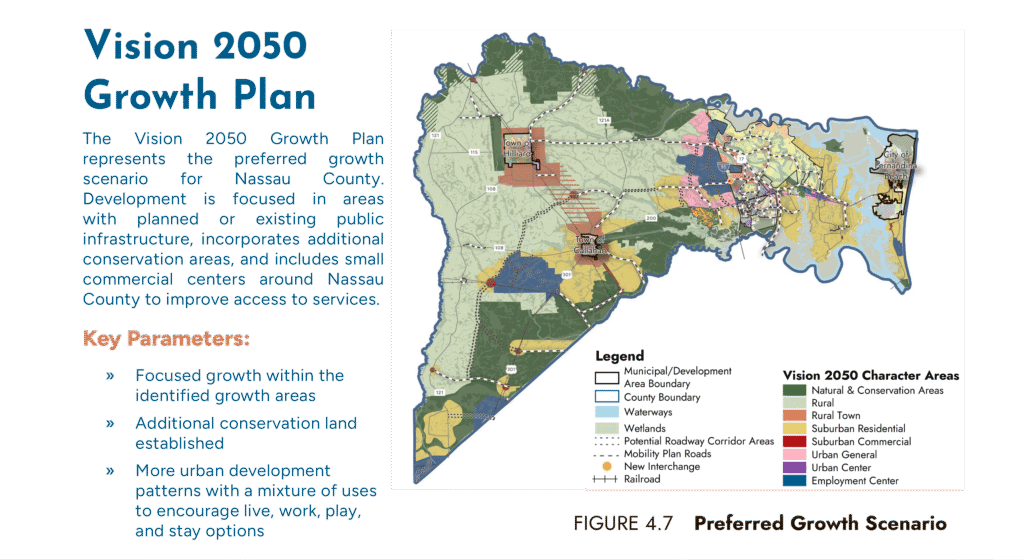
The answer, shaped by thousands of residents and compiled into a sweeping long-range plan known as Vision 2050, aims to preserve the community’s character, natural environment and financial stability as population growth accelerates.
Since 2011, the county has added roughly 30,000 residents. By mid-century, projections show Nassau approaching a population of 200,000—growth that officials say will strain schools, wastewater systems, emergency response capacity and the county road network if not carefully managed.
Vision 2050, developed between fall 2023 and summer 2025, has become the framework for how Nassau intends to absorb that growth without sacrificing the qualities residents say they value. The plan outlines a set of objectives that now guide policy decisions by the Board of County Commissioners and its advisory committees.
Controlling the pace
Commissioner A.M. “Hupp” Huppmann, who frequently hears concerns about growth from residents, said the plan is designed to strike a balance between inevitable development and the community’s desire to maintain what makes Nassau unique.
“You can’t stop growth, but you can control the pace at which it happens and shape it where you want to see that growth go,” Huppmann said. “The balance for us is maintaining the existing high quality of life while allowing for controlled growth” .
One major component of that balance is preserving the rural character of Callahan and Hilliard — an effort intertwined with conservation. Vision 2050 identifies conservation as essential not only for quality of life but also for protecting sensitive environmental areas such as the St. Marys River shoreline.
The role of entitlements
Conservation work can be complicated by property rights. Huppmann noted that landowners have “entitlements,” or the ability to pursue the most profitable use of their property.
“If you own land, you’re entitled to the best use of the land,” Huppmann said. He explained that a landowner with 50 acres isn’t just going to build 50 houses because the cost of infrastructure—roads, sidewalks, water and sewer—requires higher density to be financially viable .
Clarifying the vision
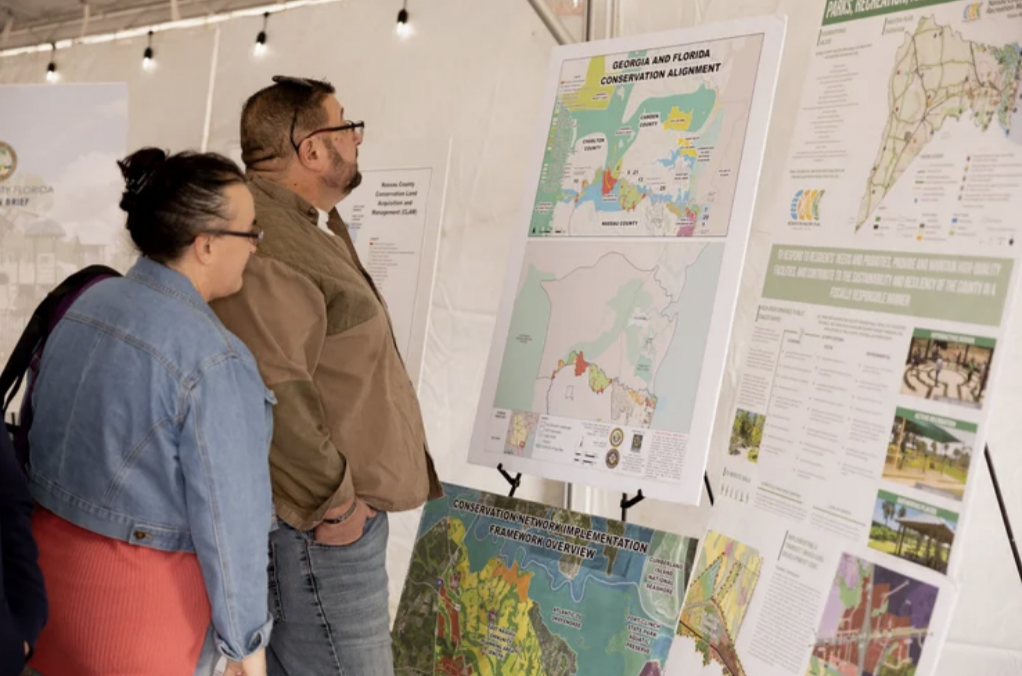
To counter that, the county’s Conservation Land Acquisition and Management Committee has identified the top 25 conservation priorities across Nassau and has been working directly with landowners who might otherwise choose development.
Throughout the 18-month development of Vision 2050, Huppmann said thousands of residents voiced worry that development would outpace infrastructure and erode the county’s character. The plan’s gradual, intentional approach was built partly in response to those concerns .
Huppmann stresses that the county does not intend for growth to feel sudden or overwhelming.
He also clarified a term found on county planning maps: “Think Big.”
“Let’s take the words ‘Think Big’ off of this, because what that meant was the county needs to think big—outside the box… It doesn’t mean think big like let everything grow,” Huppmann said. “That’s a term that we would change now if we could” .
Jobs closer to home
Another key priority is strengthening the local job market. Many Nassau residents currently commute elsewhere for work, a pattern Vision 2050 seeks to change.
“We don’t want people leaving Nassau to go to work, we want to bring jobs to Nassau,” Huppmann said.
To support that goal, the plan incorporates an employment center on the south end of the county—a project expected to bring hundreds of jobs closer to home.
As Vision 2050 begins guiding decisions large and small, county officials say its purpose is simple: to protect the place residents love while preparing for the people who will soon call Nassau home.
kkimmel@nassaunewsline.net